
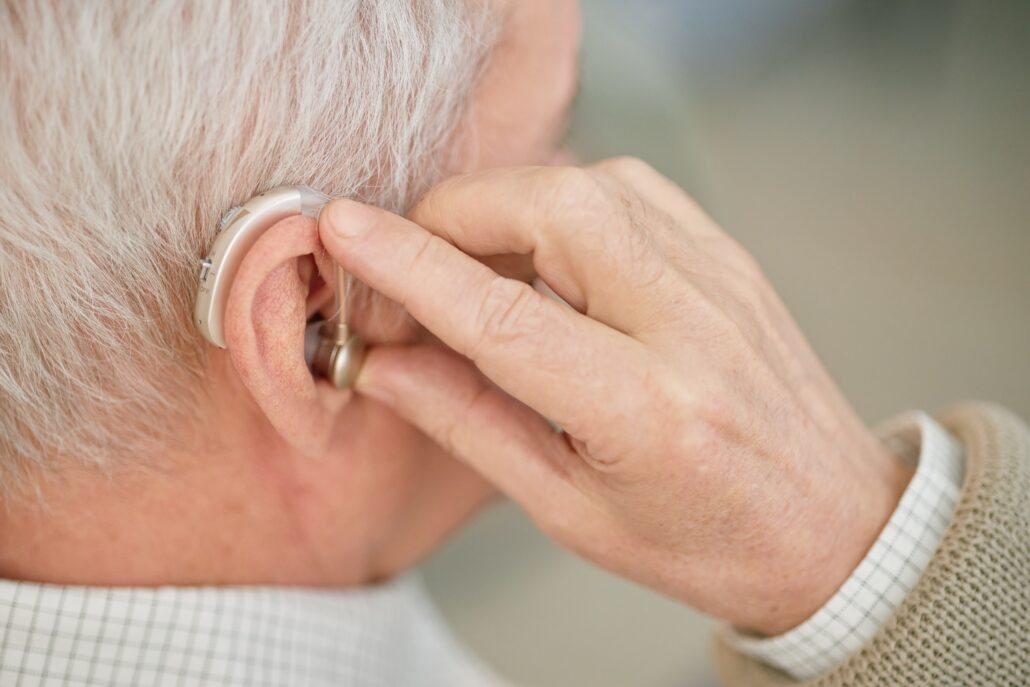
A decline in hearing ability, up to and including complete hearing loss (=deafness).
1.) World Health Organization (WHO). Risk reduction of cognitive decline and dementia: WHO guidelines, second edition. Geneva: World Health Organization; 2026. Licence: CC BY-NC-SA 3.0 IGO. ISBN 978-92-4-012355-7
2.) Anastasiadou, S., & Al Khalili, Y. (2023, May 23). Hearing loss. In StatPearls. StatPearls Publishing. https://www.ncbi.nlm.nih.gov/books/NBK542323/
Why is hearing loss a risk factor for dementia?
| Background | The more severe the hearing loss, the higher the risk of developing dementia. |
| Mechanisms: | Hörverlust trägt zu einem Kettenreaktionseffekt bei, der zu einer Abnahme der sozialen Teilnahme, des psychischen Wohlbefindens und der körperlichen Aktivität führt, was das Risiko für einen kognitiven Abbau und Demenz erhöhen kann. Psychosocial Factors, such as loneliness, depression, and social isolation, can be exacerbated by hearing loss, as hearing loss hinders social interaction. Hearing loss can lead to a reduction in cognitive reserve (a kind of buffer that helps the brain compensate for declining mental performance) due to reduced environmental stimuli, an increased demand for the cognitive resources required for listening, or a combination of both factors. The cause may be zugrundeliegende Gefäßerkrankungen oder Herz-Kreislauf-Erkrankungen sein, die sich sowohl auf die Cochlea (Hörschnecke) als auch auf Teile des menschlichen Gehirns (Temporallappen) auswirken. |
1.) Livingston G, Huntley J, Liu KY, Costafreda SG, Selbæk G, Alladi S, Ames D, Banerjee S, Burns A, Brayne C, Fox NC, Ferri CP, Gitlin LN, Howard R, Kales HC, Kivimäki M, Larson EB, Nakasujja N, Rockwood K, Samus Q, Shirai K, Singh-Manoux A, Schneider LS, Walsh S, Yao Y, Sommerlad A, Mukadam N. Dementia prevention, intervention, and care: 2024 report of the Lancet standing Commission. Lancet. 2024 Aug 10;404(10452):572-628. doi: 10.1016/S0140-6736(24)01296-0. Epub 2024 Jul 31. PMID: 39096926.
2.) World Health Organization (WHO). Risk reduction of cognitive decline and dementia: WHO guidelines, second edition. Geneva: World Health Organization; 2026. Licence: CC BY-NC-SA 3.0 IGO. ISBN 978-92-4-012355-7
What can I do?
People who notice a decline in their hearing or are told by others that their hearing has deteriorated should have their hearing checked regularly and consult a hearing aid specialist.
Test your hearing right here, easily and conveniently, with the digiDEM Bayern Online Hörtest.
If hearing loss has been diagnosed, a hearing aid should be used . Long-term studies have shown that hearing aids are the key protective factor in reducing the risk of dementia associated with hearing loss.
Hörgeräte sollten zur Behandlung von Hörverlust eingesetzt werden und nicht ausschließlich zum Zweck der Demenzprävention dienen. Die Wirksamkeit von Hörhilfen kann je nach Art und Schweregrad des Hörverlusts sowie dem Umfang der Nutzung des Geräts variieren. [
1.) Livingston G, Huntley J, Liu KY, Costafreda SG, Selbæk G, Alladi S, Ames D, Banerjee S, Burns A, Brayne C, Fox NC, Ferri CP, Gitlin LN, Howard R, Kales HC, Kivimäki M, Larson EB, Nakasujja N, Rockwood K, Samus Q, Shirai K, Singh-Manoux A, Schneider LS, Walsh S, Yao Y, Sommerlad A, Mukadam N. Dementia prevention, intervention, and care: 2024 report of the Lancet standing Commission. Lancet. 2024 Aug 10;404(10452):572-628. doi: 10.1016/S0140-6736(24)01296-0. Epub 2024 Jul 31. PMID: 39096926.
2.) World Health Organization (WHO). Risk reduction of cognitive decline and dementia: WHO guidelines, second edition. Geneva: World Health Organization; 2026. Licence: CC BY-NC-SA 3.0 IGO. ISBN 978-92-4-012355-7