The digital dementia register in Bavaria researches and improves the structure of services for people with dementia and their relatives
digiDEM Bayern Präventionscoach®
Lower your dementia risk – with the digiDEM Bayern Präventionscoach®
A healthy lifestyle can prevent many diseases and also help delay the development of dementia. Therefore, it is important to know the risk factors for dementia and how they can be modified.
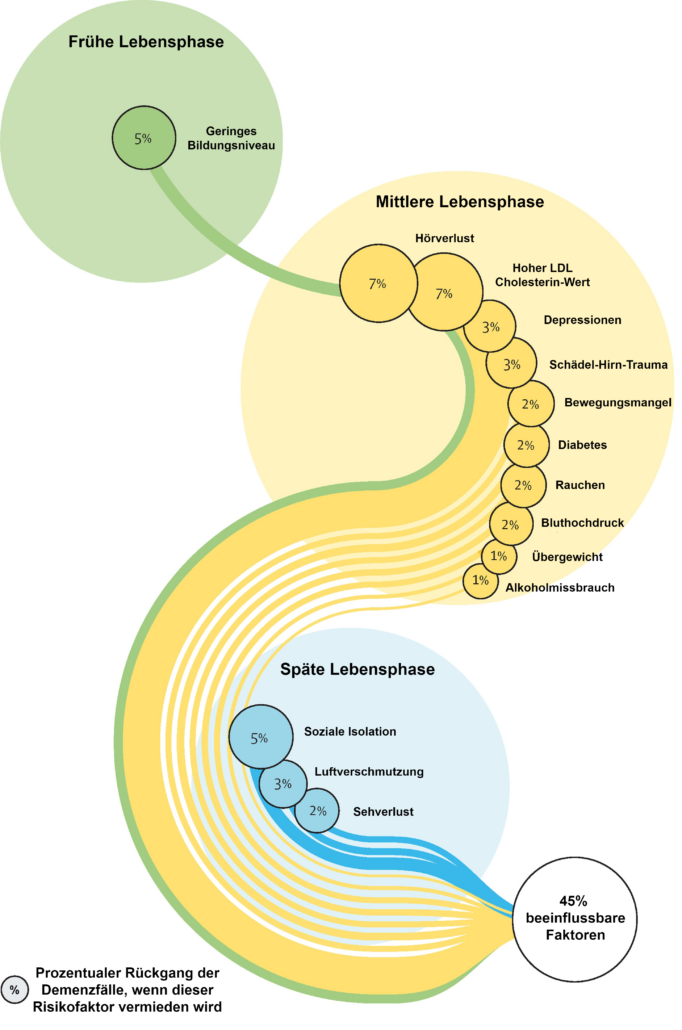
In July 2024, an international team of dementia experts published a revised list of now 14 risk factors. It is scientifically proven that these increase the risk of developing dementia. These factors are linked to 45 percent of all dementia cases.
But which risk factors promote dementia? Why are risk factors such as declining hearing and vision, low education, depression, social isolation, or physical inactivity associated with the likelihood of developing dementia?
What can you do proactively for your cognitive health?
With our digiDEM Bayern Präventionscoach®, we want to encourage you to learn about your personal dementia risk factors in just a few steps.
Learn how to keep your brain actively fit in everyday life and find out about ways to reduce your risk of dementia.
Heed our practical, evidence-based tips for dementia prevention and learn how to achieve a lot for your cognitive health with little effort.
Join our quick quiz and test your new knowledge right away.
In 2024, a specialist commission vividly structured 14 risk factors into the form of the life cycle. According to this, different risk factors are relevant in early, middle, and late human life stages. For example, in middle age, hearing loss is an important risk factor for dementia. Smoking or social isolation, on the other hand, increase the probability of developing dementia in later life.
Modifiable risk factors for dementia (Figure adapted from Livingston 2024)
Start now with thedigiDEM Bayern Präventionscoach®
Click on one of the following menu items – and let's go!
Early life
Low level of education
A low level of education refers to a low degree of formal schooling, where basic knowledge in important areas such as reading, writing, mathematics, and general knowledge is insufficient or absent.
Elevated LDL cholesterol levels indicate a high concentration of low-density lipoprotein cholesterol in the blood, which can deposit in the arteries and increase the risk of dementia and strokes.
Depression is a mental health condition characterized by persistent sadness, loss of interest, emptiness, or irritability that can significantly impair functioning.
Normal blood pressure in adults is systolic below 140 mmHg and diastolic below 90 mmHg. High blood pressure is defined as when at least one of these two values is persistently elevated.
Overweight and obesity are defined as abnormal or excessive fat accumulation that presents a health risk. A body mass index (BMI) over 25 kg/m² is considered overweight, and over 30 kg/m² is considered obese.
Air pollution refers to the contamination of indoor or outdoor air by chemical, physical, or biological substances that affect the natural properties of the atmosphere.
We use cookies on our website to give you the best possible experience by remembering your preferences and repeat visits. By clicking "Accept all", you consent to the use of ALL cookies. However, you can visit the "Cookie Settings" to give controlled consent.
This website uses cookies to improve your experience while you navigate through the website. Out of these, the cookies that are categorized as necessary are stored on your browser as they are essential for the working of basic functionalities of the website. We also use third-party cookies that help us analyze and understand how you use this website. These cookies will be stored in your browser only with your consent. You also have the option to opt-out of these cookies. But opting out of some of these cookies may affect your browsing experience.
Necessary cookies are absolutely essential for the website to function properly. These cookies ensure basic functionalities and security features of the website, anonymously.
Cookie
Duration
Description
cookielawinfo-checkbox-analytics
11 months
This cookie is set by GDPR Cookie Consent plugin. The cookie is used to store the user consent for the cookies in the category "Analytics".
cookielawinfo-checkbox-functional
11 months
The cookie is set by GDPR cookie consent to record the user consent for the cookies in the category "Functional".
cookielawinfo-checkbox-necessary
11 months
This cookie is set by GDPR Cookie Consent plugin. The cookies is used to store the user consent for the cookies in the category "Necessary".
cookielawinfo-checkbox-others
11 months
This cookie is set by GDPR Cookie Consent plugin. The cookie is used to store the user consent for the cookies in the category "Other.
cookielawinfo-checkbox-performance
11 months
This cookie is set by GDPR Cookie Consent plugin. The cookie is used to store the user consent for the cookies in the category "Performance".
viewed_cookie_policy
11 months
The cookie is set by the GDPR Cookie Consent plugin and is used to store whether or not user has consented to the use of cookies. It does not store any personal data.
Functional cookies help to perform certain functionalities like sharing the content of the website on social media platforms, collect feedbacks, and other third-party features.
Performance cookies are used to understand and analyze the key performance indexes of the website which helps in delivering a better user experience for the visitors.
Analytical cookies are used to understand how visitors interact with the website. These cookies help provide information on metrics the number of visitors, bounce rate, traffic source, etc.
Advertisement cookies are used to provide visitors with relevant ads and marketing campaigns. These cookies track visitors across websites and collect information to provide customized ads.