

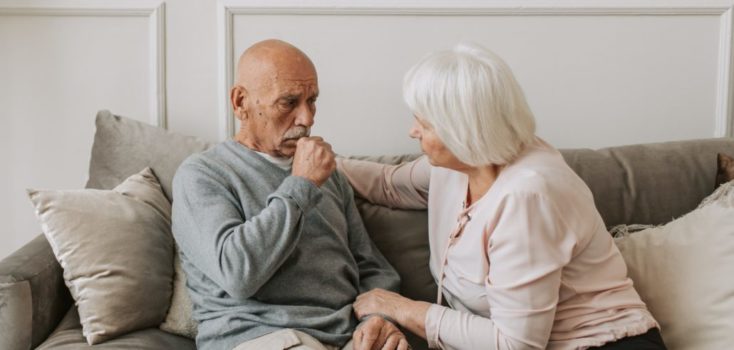
Communicating Effectively - But How? As was already clear in the last webinar, various barriers can arise when communicating with people with dementia. These hinder exchange and can thus strain the personal relationship with the affected person, making social participation more difficult.
Communication with people with dementia can be facilitated by adopting an appreciative attitude and focusing on existing resources. These two aspects are important building blocks of Integrative Validation according to Richard®, which can support relatives and/or caregivers in their interactions with people with dementia. This method is suitable for preventing conflict situations proactively and for reacting more effectively in challenging situations.
M.A. in Psychogerontology Sabine Seipp is a specialist consultant at the Competence Center for Dementia and Care in Lower Franconia (Halma e.V.), and also helped establish the Competence Center for Caregiving Relatives and the Würzburg Region Care Support Center. In the webinar, she will share various experiences in communicating with people with dementia, describing them using the example of Integrative Validation according to Richard®.
Here is the webinar as a PDF for Download.
Participant Questions and Answers from Sabine Seipp:
When you know someone better, it's usually easier because you know more about their biography and know the person from their past. For example, you then know very well what motivates them, what feelings they have, or what hobbies they enjoy. But if you have learned the method very well, you can also validate (unfamiliar) people very well in the present and try to approach them. For this, you need good sensors in order to read the person's posture and facial expression. This allows you to intuit which emotion might be prominent, so that you can mirror it very effectively. You have to fill your drawers with emotions, motivations, and turns of phrase, and then, surprisingly, you are always successful with it.
Crying is a very special topic. A lot of knowledge is needed here, for example, what underlying illnesses there are or in which situations crying occurs. Precise observation and documentation of the challenging behavior is a very important point. For example, are there times of day when these situations occur less or more often? Validation is one way to act proactively, meaning in advance. For example, approaching someone and offering them things when they are in quieter and more peaceful phases.
The point is to make people feel secure. It’s important not to confirm false statements and to step back from the situation to frame it in more general terms. You should avoid phrases like „I think it’s this way or that way…“ and instead use phrases like „That’s certainly surprising“ or „I can’t really explain that either.“ So you have to pay attention to which sentence fits the situation, so that you neither correct the person nor confirm the falsehoods. You should try to extricate yourself from the situation a bit, but it would be better to discuss this using concrete examples.
First, it's helpful to observe yourself in how you handle goodbyes and what your own attitude towards goodbyes is.
It is helpful to introduce farewell rituals (providing a drink and a small bite to eat, as snacks often help, possibly introducing a pet or an activity, sometimes it even works with a stuffed animal or similar) from the beginning and to carry them out regularly. This has a calming effect. It would also be helpful to involve another person in the care, so that one can take care of their own affairs in peace (e.g., a volunteer helper, neighborhood assistance, or similar). Depending on the situation, one could say: „It's very difficult to be alone – one would rather have someone around – I can understand that very well.“
A short walk often helps with returning to the right apartment. Perhaps taking a walk preventatively would also be an option. Returning to the „right“ apartment is usually driven by a need for security and comfort. These basic needs can be identified. It might also be possible to offer an activity from their life story or a new activity. Discuss the situations with other people/a counseling center – conduct a role-play yourself and see what is most calming for you. What do you need to feel at home?
Our speaker recommends:
Feil, N., & de Klerk-Rubin, V. (2017). Validation: A Path to Understanding Confused Elderly PeopleChen. Ernst Reinhardt Publishing House.
Richard, N., & Richard, M. (2016). THE INTEGRATIVE VALIDATION by Richard® (2nd ed.). Self-published by Institut für Integrative Validation GbR, Carlo and Monika Richard.
Richard, N., & Richard, M. (2016). Integrative Validation® – Respectfully Engaging with People with Dementia (2nd ed.). Self-published by Institut für Integrative Validation GbR, Carlo and Monika Richard.
Tuesday, 02/08/2022, 11:00 AM - 11:45 AM

Anne Keefer
Research Associate, M.Sc.Moderation

Jana Rühl
Research Associate, M.Sc.Support Chatroom & Questions
Are you interested in further webinars on topics from international dementia research? In our Media library Find all past webinars as video recordings.
With the webinar series „Science Watch LIVE,“ we offer an additional service to our monthly newsletter digiDEM Bavaria Science WaOkay, where we provide scientific findings from dementia research.
Against the backdrop of widespread half-truths and fake news, currently, for example, concerning the new coronavirus, evidence-based science is in demand. It is more important than ever to communicate scientific findings in a way that is understandable to society and to promote an exchange about them. This is what we at the digiDEM Bavaria project team would like to contribute to, now also with digiDEM Bavaria Science Watch LIVE.