
Technology-supported remote care

What solutions are there for elderly people in need of care whose adult only children would gladly care for them, but live far away or even abroad? They want to take responsibility, but often cannot provide direct care. Smart home technologies and assistance robots seem to offer a solution at first glance: they promise safety, health monitoring...

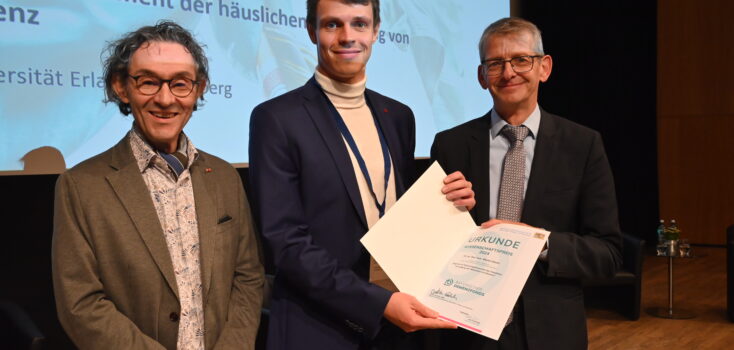
„Data for Action“: Science Award for Dr. Nikolas Dietzel

The digiDEM Bavaria team congratulates warmly: Our colleague Dr. Nikolas Dietzel was honored with the Science Award of the Bavarian Dementia Fund at the Meistersingerhalle in Nuremberg. During the 10th Bavarian Dementia Conference, our colleague Dr. Nikolas Dietzel's dissertation was awarded the Science Award of the Bavarian Dementia Fund 2024. „It is an honor for me...

digiDEM Bavaria Sets Record for Number of Dementia Screening Days 

During the 6th Bavarian Dementia Week, the digiDEM Bayern research project made a significant contribution to the early detection of dementia by holding a record 62 dementia screening days at locations throughout Bavaria—more than in previous Bavarian Dementia Weeks. Around 1,500 people took advantage of the opportunity to be screened, of whom 23 percent …

Development of New Drugs for Dementias – Current Status and Outlook

After decades of stagnating research, there's renewed momentum: new monoclonal antibodies against amyloid deposits, such as Lecanemab or Donanemab, are directly targeting the disease mechanisms of Alzheimer's dementia for the first time. Previous medications could only alleviate symptoms, but not slow the progression of the disease. How promising are the new drugs – and…

Suicidality in people with dementia 

Recent research has already shown a connection between dementia and suicide risk. Scientists from Great Britain have now investigated in a current publication to what extent the suicide risk differs between various types of dementia. Understanding the differences is of great importance for several reasons. Suicidal thoughts, suicide attempts, and suicide deaths are usually counted under...

Frontotemporal Dementia: When Criminal Prosecution Looms

Criminal risk-taking behavior occurs more frequently in people with frontotemporal dementia (FTD) than in people with other forms of dementia. This was discovered by researchers from Germany, the Netherlands, and Australia. Their study was published in August 2025 in the internationally renowned journal Nature Translational Psychiatry. Neurodegenerative diseases such as dementia can not only affect memory...

DiGA: Lack of Scientific Evidence

Digital health applications (DiGA) are used to detect, monitor, treat, or alleviate the symptoms of diseases. However, in Germany, only those DiGAs that have been approved by the Federal Institute for Drugs and Medical Devices (BfArM) are reimbursed by statutory health insurance funds. Safety and data protection requirements are among the first aspects to be examined. Afterward…

Webinar: Development of New Drugs for Dementia - Current Status and Outlook

After decades of stagnating research, there's renewed momentum: new monoclonal antibodies against amyloid deposits, such as Lecanemab or Donanemab, are directly targeting the disease mechanisms of Alzheimer's dementia for the first time. Previous medications could only alleviate symptoms, but not slow the progression of the disease. How promising are the new drugs – and…