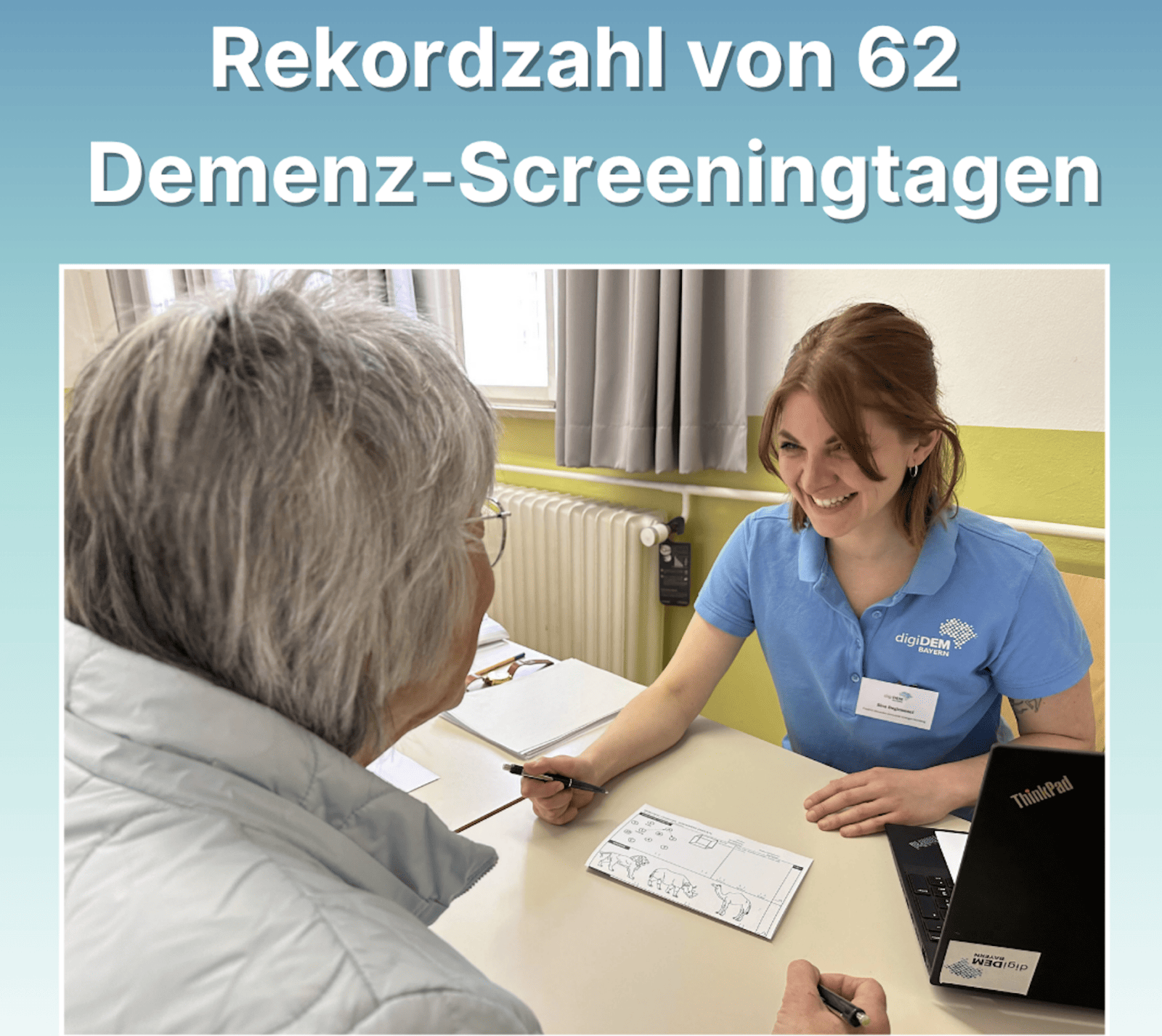
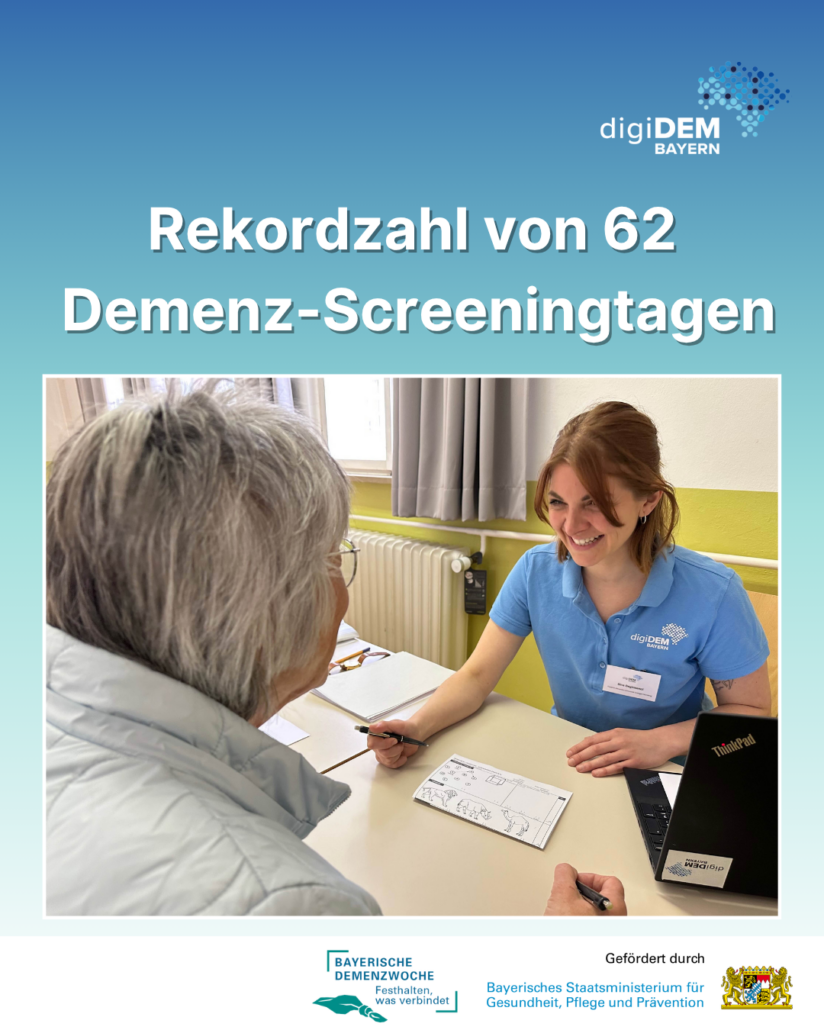
On the occasion of the 6th Bavarian Dementia Week, the digiDEM Bavaria research project made a significant contribution to the early detection of dementia with a record 62 dementia screening days compared to previous Bavarian Dementia Weeks, held at locations across Bavaria. Around 1,500 people took the opportunity to be tested, with 23 percent of them receiving results that require further clarification. Over 80 percent of the screening days took place in rural areas. In total, 220 testing days have been held within the scope of the project since summer 2022. Around 6,000 people had their memory performance checked, with 26 percent receiving test results that require further clarification (as of November 10, 2025).
„Never before have so many screenings for early detection of dementia been carried out nationwide in Germany within such a short period,“ says Prof. Dr. Peter Kolominsky-Rabas, neurologist and project leader of digiDEM Bayern. „Only through intensive collaboration with our digiDEM Bayern research partners and on-site project assistants were we able to offer this extensive number of testing opportunities.“
Bavarian Health Minister Judith Gerlach emphasized: „The dementia screening days organized by digiDEM Bayern show that targeted healthcare services are effective – especially in rural regions. I am very pleased that many citizens took advantage of a screening, as an early diagnosis is crucial to preserve the everyday skills of people with dementia for as long as possible.“
The demand for dementia screenings is high: „The dementia screening days are usually fully booked. This shows us how great the interest and need for low-threshold testing opportunities is among the population. Especially older people who notice a decline in their memory are grateful to take advantage of the offer,“ explains Prof. Dr. Peter Kolominsky-Rabas. A short scientific test is used to check cognitive abilities such as short-term memory, attention, and orientation.
Dementia remains underdiagnosed.
Dementia is often still associated with reservations. This is also reflected in the high number of people with dementia who have not been diagnosed. In Germany, it is estimated that 60 percent of those affected have not yet received a diagnosis. The dementia screening days organized as part of digiDEM Bayern can help pave the way for more people to seek diagnostic clarification, thus improving the care situation for those affected and their relatives and caregivers.
At the same time, they also raise greater awareness of the topic of dementia, thus helping to create understanding and reduce prejudice. „However, it is important to work across society to make the living environment more dementia-friendly in order to lower this hurdle for diagnosis,“ emphasizes Prof. Dr. Elmar Gräßel, also a project manager at digiDEM Bayern. Because even without a diagnosis, the disease progresses in those affected, but it brings numerous challenges, especially in interpersonal relationships, which can be overcome with a diagnosis.
Caring for rural areas
With the dementia screening days, digiDEM Bavaria sends a strong signal for proactive care and equal living conditions between urban and rural areas. As part of the Bavarian Dementia Week, 81 percent of the screening days took place in rural areas. In doing so, digiDEM Bavaria actively contributes to sustainably improving healthcare for older people throughout Bavaria. The initiative aligns with the goals of the Bavarian State Parliament's Enquete Commission „Equal Living Conditions throughout Bavaria,“ which advocates for greater participation, quality of life, and equity in care in the Free State.
Especially in rural areas, the importance of actively caring for the local population becomes apparent. Rural areas are often particularly affected by demographic change: the population is declining and aging disproportionately, while supply structures are often insufficient. The feeling of being left alone and limited access to help not only lead to hopelessness but can also foster social tensions and extremism.
Close cooperation with research partners
The vision of dementia screening days was first implemented in the municipality of Thüngersheim (Lower Franconia) in 2022. „What began in Thüngersheim has developed into a Bavaria-wide success story,“ explains digiDEM Bavaria Project Manager Prof. Dr. Kolominsky-Rabas. „We warmly thank Mayor Michael Röhm for his pioneering spirit, with which he laid the foundation for this development.“
To conduct nationwide regional population screenings, digiDEM Bayern has established a Bavaria-wide network with approximately 300 research partners and project assistants throughout Bavaria (as of November 10, 2025). The network includes outpatient care services and day care facilities, specialist centers for caregivers, memory clinics, medical practices, pharmacies, hospitals, assisted living facilities, and the established health regions in Bavaria.Plus and other actors engaged in dementia care.
digiDEM Bavaria as a supporter of municipalities and utility companies
digiDEM Bayern will continue to support municipalities in close cooperation with the health regions in the future.Plus available. Interested municipalities and utility companies that wish to organize and conduct a dementia screening day on-site can contact the digiDEM Bavaria project team directly. A registration form has been set up for this purpose, which municipalities and utility companies can use to submit inquiries. The registration form is available at this link.
The memory tests are aimed at people aged 65 and over who have noticed a decline in their own memory or whose close contacts have noticed a decline in their mental performance. digiDEM Bavaria is funded and actively supported by the Bavarian State Ministry of Health and Care (StMGP) as part of the Bavarian Dementia Strategy.
Do you know about digiDEM Bayern's digital offerings for people with dementia and their relatives and caregivers? Here you can find our digital offerings.