

Memory clinics (MC) can significantly contribute to qualified dementia diagnostics. Since the accessibility of medical facilities is an important predictor of their utilization, the aim of this study was to analyze the accessibility of memory clinics for people with dementia in Bavaria.
The original publication can be found in the journal: The healthcare system
Maps and graphics in color for download:
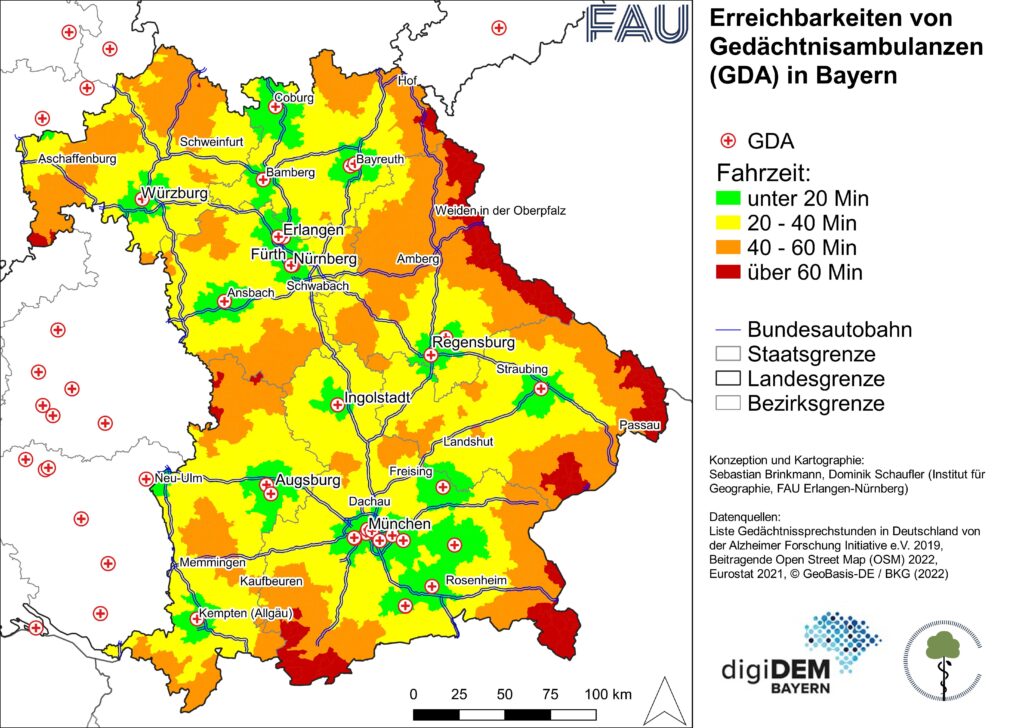
Map of GDA accessibility in Bavaria
The majority of people with dementia in Bavaria (40%; n = 93,950) live in communities where the average travel time to the nearest memory clinic is 20 to 40 minutes. Just under 7,000 people (3%) require more than an hour. People from rural communities, in particular, have to travel significantly longer distances than those from urban areas.

Scenario Simulation for the Upper Palatinate
In particular, individuals from Upper Palatinate communities near the Czech border must travel long distances to the nearest memory clinic. Therefore, four different scenarios were modeled to simulate the impact of a potential new memory clinic.

Travel times to the nearest GDA for MmD in various example scenarios in the Upper Palatinate
The results show that, at the time of the study (50%), more than 40 minutes’ travel time from the nearest memory clinic was required for 50% of the estimated number of people with dementia (9,693). In scenario b) with an additional location in Amberg, this proportion drops to 25% (n = 5,002), and in scenario c) with a new memory clinic in Weiden, it drops to as low as 18% (3,530). With a memory clinic in both cities (scenario d), only 13% of the modeled population with dementia (2,619) would have to travel more than 40 minutes.