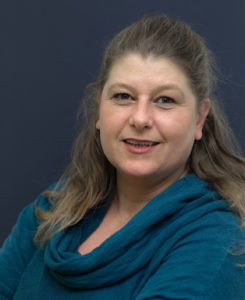
Angelika Bleicher has already interviewed several people with dementia and their caregivers for digiDEM Bavaria. The employee of the Caritas Association for the City and District of Fürth works at the Veitsbronn Senior Center and thus has contact with many older people. In the interview, she reports on her experiences during the interviews and the situation of those affected during the Corona pandemic.
How many surveys have you conducted so far?
So far, I have conducted four interviews. Two more are currently on “hold.” I was fortunate to schedule the first four appointments between lockdowns. This allowed me to visit the participants in their homes. The next two interviews will be uncharted territory for me: due to the lockdown, I will be conducting them as video interviews using “Jitsi” for the first time.
How was contact established with the affected individuals?
First, I considered which clients from my counseling practice might be suitable for the project and approached them. This led to the first four interviews. Then, some time ago, we were able to publish an article about digiDEM Bayern in the Fürther Nachrichten. After that, more people came forward: two individuals with dementia who are cared for by their relatives and wish to be interviewed together with them, and one person who lives alone. I will likely interview the first two using “Jitsi,” but I definitely want to visit the person living alone in person. So, that will have to wait a bit longer.
At what stage of the disease are the surveyed individuals with dementia?
The four people interviewed so far all have early-stage dementia. I don't know about the three new ones yet, as the screening is still pending. The initial test is definitely worthwhile!
Where did you conduct the surveys and what was the mood like?
I was able to conduct all previous interviews as home visits. The people were very motivated to participate. They were happy that such research project exists and are excited about the results. The caregivers found it very good that they also had a voice. For the respondents, the interviews apparently also represent a kind of “milestone” in the course of the illness: If I come back in six months or a year later, how has the illness changed? What has gotten worse? This is of great interest, especially to the relatives.
What impact has the Corona pandemic had on those affected and on your work?
The biggest problem is that I can't make house calls right now. This is only possible for my helpers and me in very urgent cases. It's true that, unlike the first lockdown, the daycare facilities are at least open, which means the situation for those affected isn't quite as tense as it was then. But still, it's very difficult for people with dementia and their relatives. We try to advise them by phone or video. But firstly, that's not the same thing; personal contact is missing. And secondly, video consultations are only possible with the help of relatives, if at all. So, overall, it's a very difficult situation for everyone affected.