
The new Alzheimer's drug Lecanemab has raised great hopes among people with dementia and their caregivers. Most recently, an expert committee of the European Medicines Agency (EMA) recommended the new active ingredient for treatment—with strict conditions. But which patient groups meet the criteria for treatment with Lecanemab? Researchers at the Bavarian Digital Dementia Registry (digiDEM Bayern) have calculated this. They also explain who is eligible for treatment with Lecanemab.
The new active ingredient Lecanemab is a „monoclonal antibody“ and specifically targets spot-like protein deposits in the brain, known as beta-amyloid proteins. These are associated with the destruction of nerve cells.
Recommended in the EU, but not yet approved
As early as 2023, the US Food and Drug Administration (FDA) approved Lecanemab (brand name Leqembi). The European Medicines Agency (EMA), on the other hand, had initially not agreed to its release. Only on November 14, 2024, after a renewed review process, did the EMA's Committee for Medicinal Products for Human Use (CHMP) recommend that Lecanemab could be prescribed under certain conditions.
Who is eligible for treatment?
Lecanemab may only be prescribed in Europe to people with mild cognitive impairment (MCI) or those in the early stages of Alzheimer's dementia. However, treatment with Lecanemab is subject to strict conditions for these patients.
The first condition for treatment with lecanemab is the detection of amyloid deposits in the brain. This detection can be done through cerebrospinal fluid sampling (lumbar puncture) or amyloid positron emission tomography (amyloid PET).
The EMA has attached another condition to the administration of Lecanemab. The drug may only be used to treat people who have either no or at most one genetic copy of the so-called ApoE4 gene. This is because individuals carrying a double copy of the ApoE4 gene have an increased risk of severe side effects, known as amyloid-related imaging abnormalities (ARIA), when treated with Lecanemab. These can manifest as cerebral edema (brain swelling) or brain hemorrhages.
Initial estimates for Germany
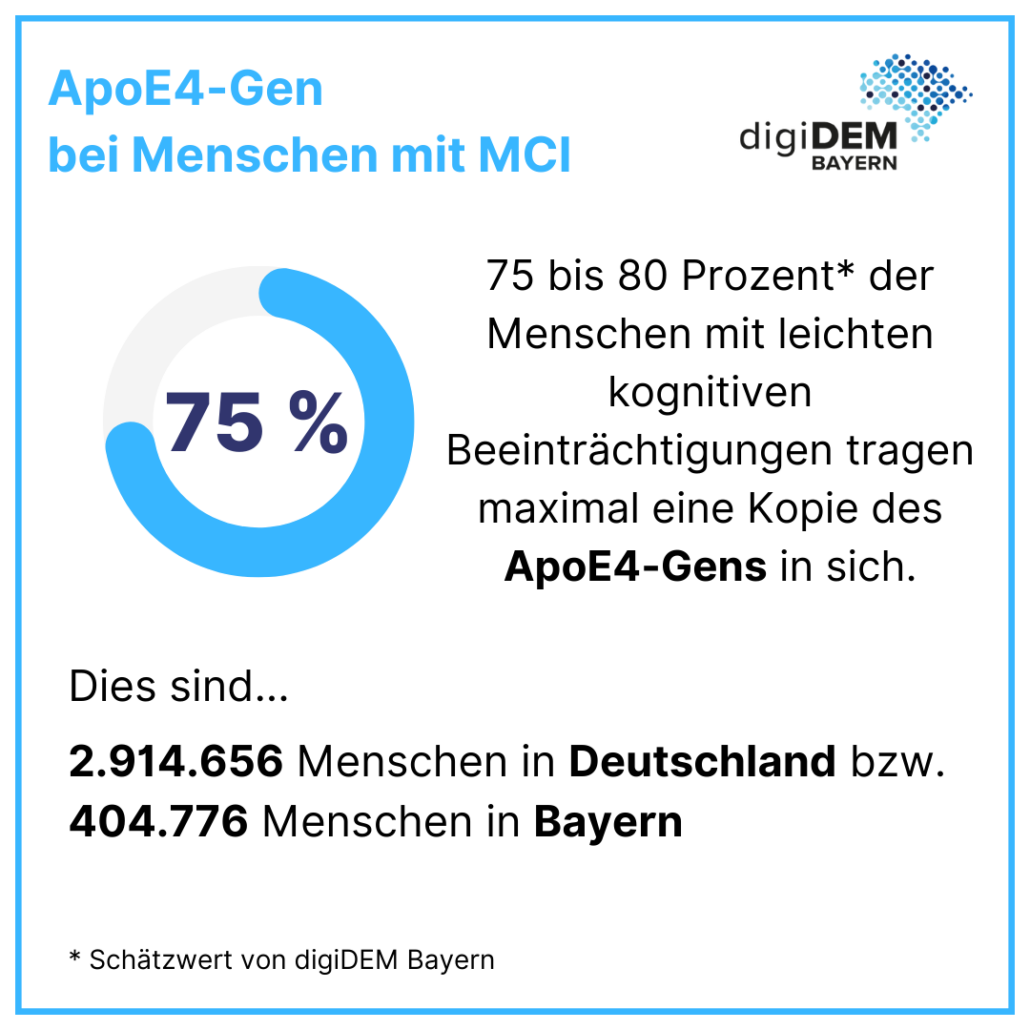
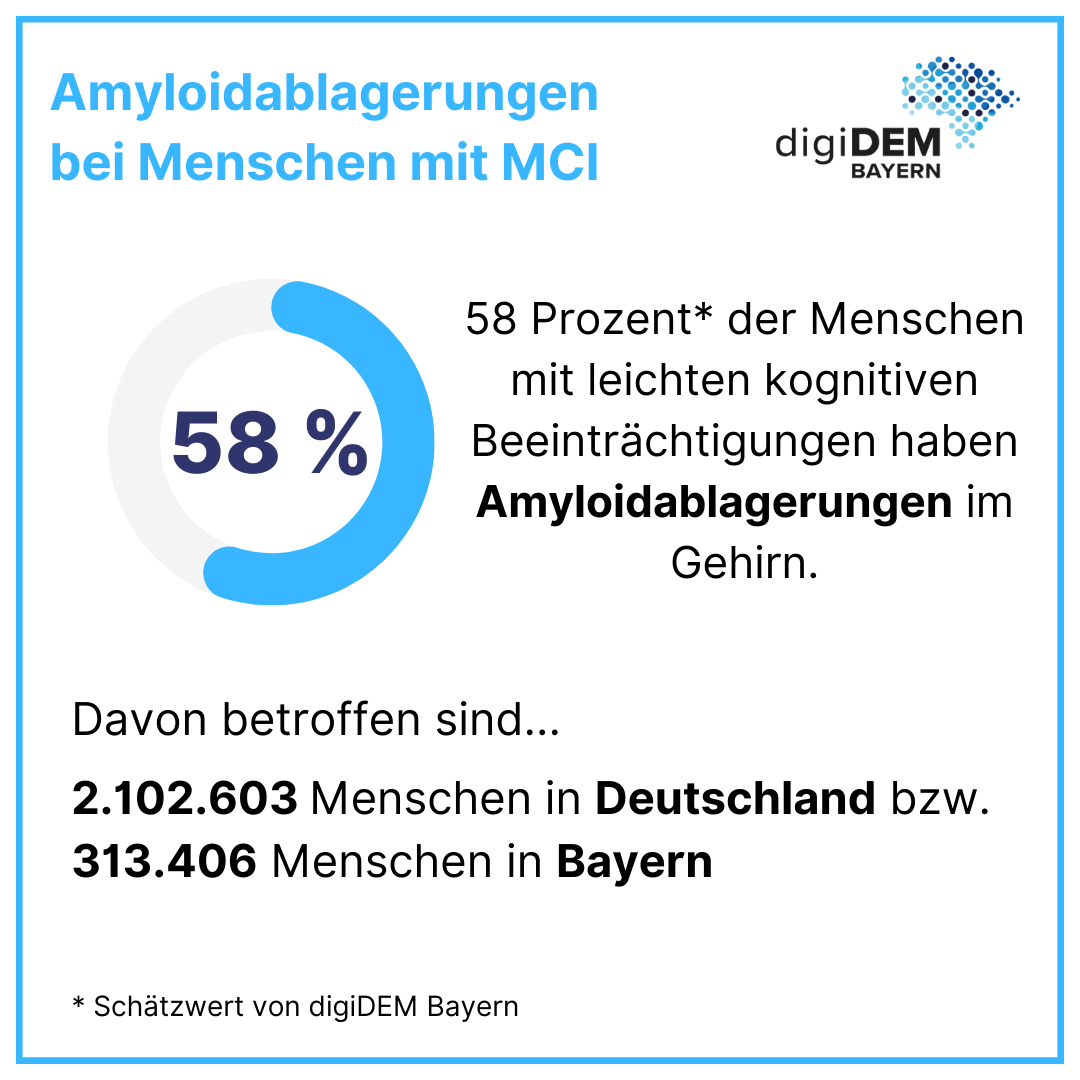
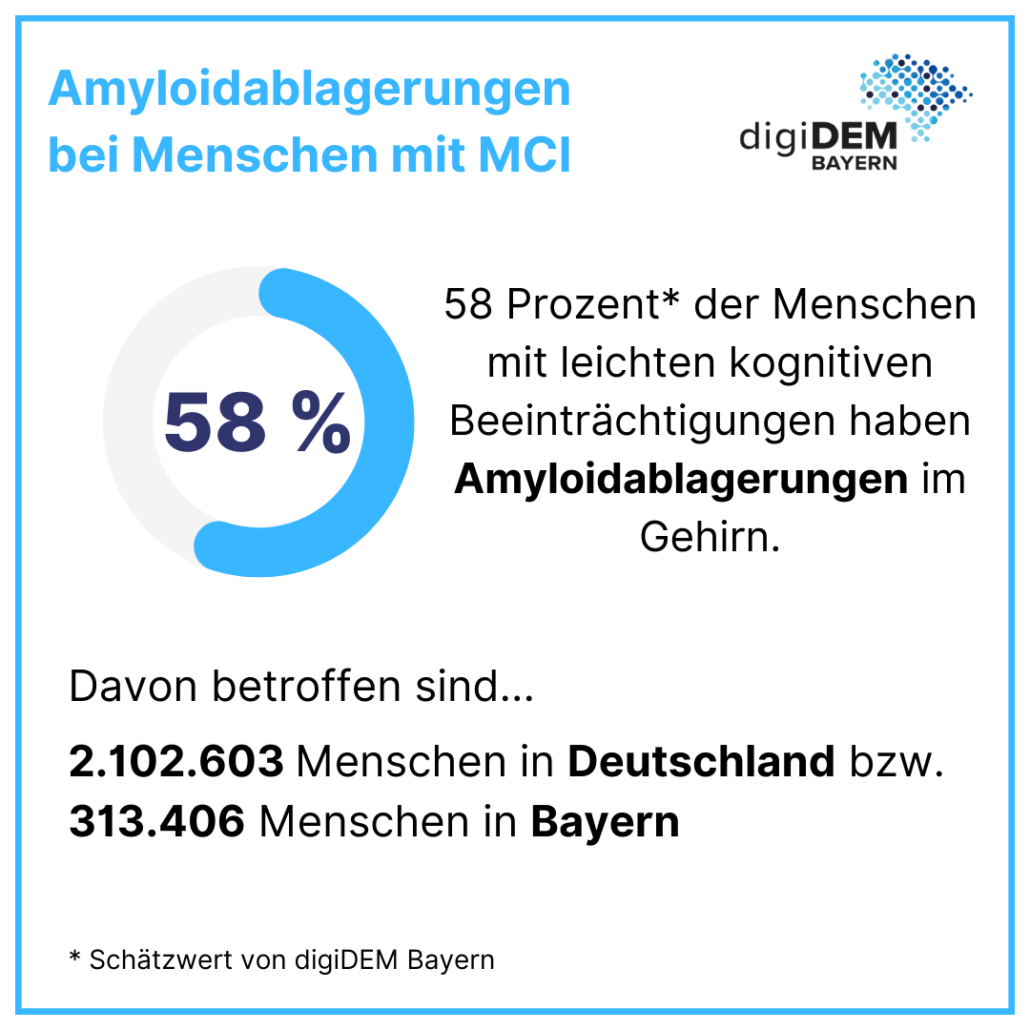
The digiDEM Bavaria research team, led by Jana Rühl, has calculated estimates of patient groups that are fundamentally eligible for treatment with Lecanemab based on international studies. Accordingly, there are a total of 3,623,661 people aged 60 and over in Germany who with mild cognitive impairments life. After evaluating the data sources, it is to be assumed that 2,102,603 people in this group have amyloid deposits. In contrast, 2,914,656 people with MCI carry at most one copy of the ApoE4 gene.
The reference figures for the 593,296 people in Germany who with mild Alzheimer's dementia live and are 60 years or older. Of these, 478,864 people have amyloid deposits. The number of people with mild Alzheimer's dementia who additionally have at most one copy of the ApoE4 gene is 493,855.
Situation of those affected in Bavaria
The digiDEM Bavaria researchers have also estimated the situation of those affected in the group aged 60 and over in Bavaria. Out of a total of 541,825 People with mild cognitive impairments Amyloid deposits can be assumed in 313,406 individuals. Of the 541,825, 404,776 have a maximum of one copy of the ApoE4 gene.
The extent to which the 87,997 people living in Bavaria People with mild Alzheimer's dementia are affected by amyloid deposits. Of these, 71,049 are people aged 60 or older, while 73,190 have at most one copy of the Apoe4 gene.
Regarding the specific total number of patients who meet the criteria for treatment, Prof. Dr. Peter Kolominsky-Rabas, neurologist and one of the project leaders of digiDEM Bayern, emphasizes: „Regarding the number of affected individuals in the general population who simultaneously have amyloid deposits and the ApoE4 risk gene, there are no scientific studies.“ He summarizes: „Only a comparatively small and restricted group of people is eligible for treatment with Lecanemab. Which patients can receive Lecanemab fundamentally requires a detailed case-by-case review.“
For the estimations, digiDEM Bayern used the following scientific data sources:
Federal Statistical Office (DESTATIS) (2024). Update of the population status as of 12/31/2022.