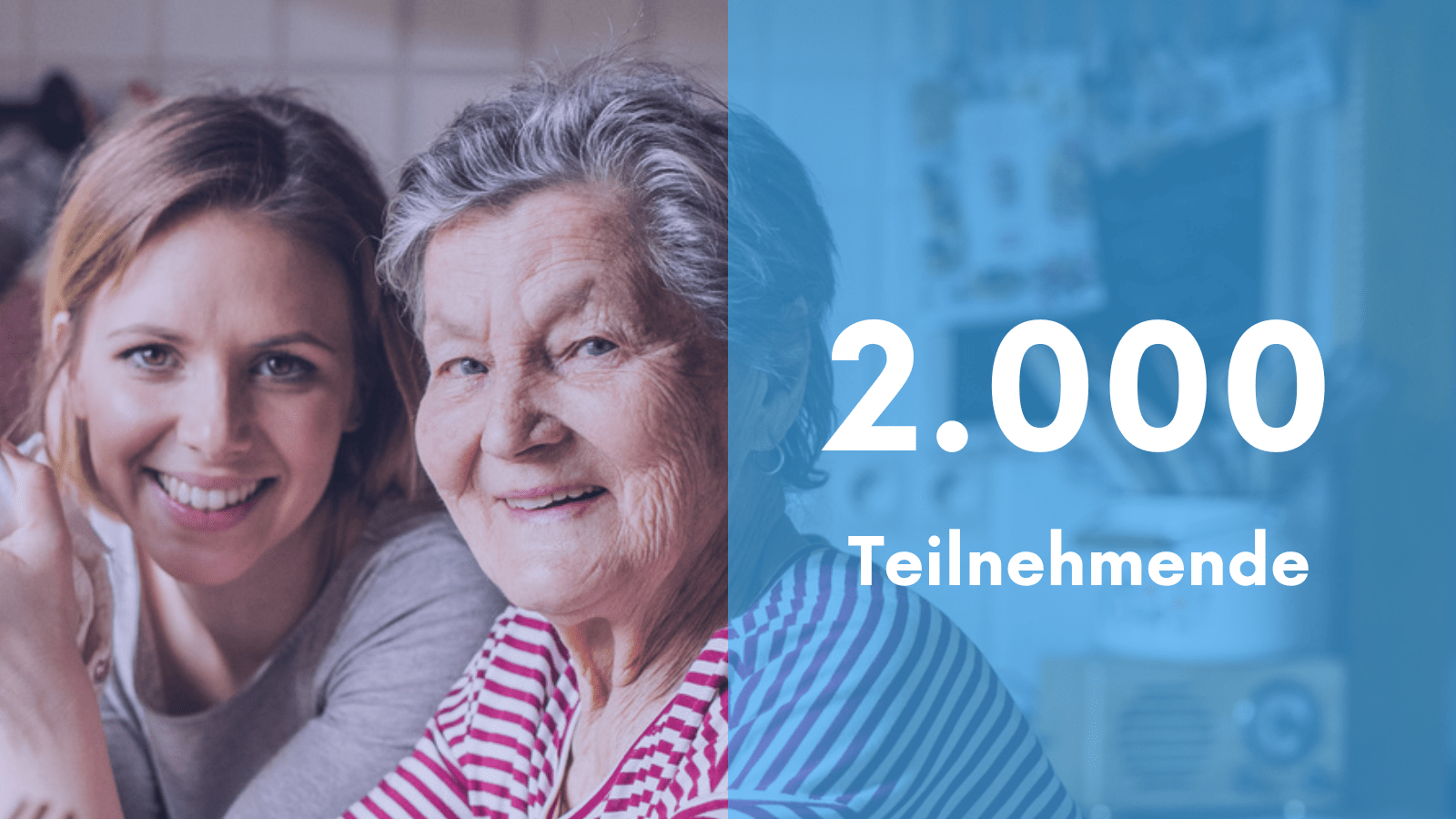

digiDEM Bayern, the largest digital dementia registry in Germany, continues to grow, reaching a new high with more than 2,000 participants from all seven Bavarian administrative districts. This special research project is one of the largest projects for collecting long-term data in the European Union (EU) in the field of dementia research. The flagship project, funded by the Bavarian State Ministry of Health and Long-Term Care (StMGP) as part of the Bavarian Dementia Strategy, aims to further advance digitalization in healthcare. The voluntary „data donations“ from over 2,000 Bavarian residents contribute to improving the care situation for people with dementia and increasing the quality of life for their caregivers and relatives.
digiDEM Bayern, the largest dementia registry in Germany, continues to grow and is now delighted to have over 2,000 participants. This marks a new all-time high. The digiDEM Bayern study surveys people with mild cognitive impairment, people with dementia, and their caregivers. „The voluntary “data donations„ from Bavarian citizens are an elementary part of our research within the framework of the long-term Bavarian Dementia Strategy,“ explains digiDEM Bayern project leader Prof. Dr. Peter Kolominsky-Rabas. In this context, digital health technologies are becoming increasingly important for data analysis. „In registry research with digital data, the use of Artificial Intelligence (AI) has great potential to complement traditional statistical methods of scientific data analysis.“ The neurologist says: "The digital data treasure allows us to give something back to those affected in the form of scientifically substantiated insights into the care situation throughout Bavaria. This includes freely accessible and practical digital tools."
Development of digital tools for people with dementia
These include, for example, the digiDEM Bavaria online questionnaire for assessing memory performance and the digital questionnaire „digiDEM Bayern DEMAND®“, which allows one to assess their personal care needs. Both offerings are successful examples of making digital access to dementia-specific health information or supportive measures easier for people. „The development of such digital tools for people with dementia is the result of innovative and consistent evaluation of health data, ensuring the quality of the collected data among other things. This shows that digitalization plays an increasingly important role in care, research, and prevention.“
For the neurologist, the continuous expansion of the dementia registry is a matter of the heart. „digiDEM Bayern stands for reliable and scientifically sound information for the public. This means that our long-term registry will also allow us to track the effects of newly developed Alzheimer's medications over the long term. Our digital monitoring allows us to evaluate Alzheimer's medications independently, transparently, and in everyday care, from the perspective of patients.“
Targeted Use of Health Data
On the occasion of the new record of more than 2,000 participants, Bavaria's Minister of State for Health, Care and Prevention, Judith Gerlach, says: „Dementia is one of the greatest challenges of our time. I am pleased that so many people affected by dementia are participating in the project and contributing to a better understanding of the long-term course of dementia. We can use the research findings from digiDEM in a targeted way for the benefit of those affected.“
Register as an important research instrument
But how exactly can the care and living conditions of people with mild cognitive impairments, people with dementia, and their caregivers in Bavaria be improved? To answer these questions, so-called registers are of great importance in medical research. In addition to clinical studies, registers are important tools for evaluating new therapies, optimizing existing treatment methods, or, as with digiDEM Bayern, improving the care of dementia patients. „The data obtained in the Bavarian Digital Dementia Register help to better understand the long-term progression of dementia diseases and to uncover care gaps, especially in rural regions of Bavaria,“ says Prof. Dr. Peter Kolominsky-Rabas.
On-site data collection in the administrative districts
The exclusively digital data collection is carried out by numerous research partners and project assistants in all seven Bavarian administrative districts for digiDEM Bavaria. „They deserve our great thanks. They are committed locally, actively participate in dementia research, and give those affected in the regions a voice,“ says Prof. Dr. Peter Kolominsky-Rabas.
Minister of State Judith Gerlach This concept is praised: „digiDEM Bayern has created an impressively large network of partners throughout Bavaria. This shows how important it is for local stakeholders to enable people with dementia to continue living in the heart of society. Digitization, especially in Bavaria's rural regions, makes a valuable contribution by meeting people where their center of life is and offering them help.“
Research partners include, among others, counseling centers, outpatient nursing services, day care facilities, clinics, outpatient clinics, specialized centers for family caregivers, memory clinics, sports groups, pharmacies, as well as doctor's offices and medical care centers (MVZs). However, individuals such as volunteers and informal caregivers also conduct data collection in their private environments.
EU-wide use of registry data as an innovation driver
The „European Health Data Space“ (EHDS) will play a significant role in the future. This European Union initiative enables the use and exchange of health data across the EU for research and healthcare. The goal is to improve healthcare, promote research, and drive innovation in the healthcare sector. The potential is enormous. The EHDS supports health registries like digiDEM Bavaria in collaborating with other registries across Europe and achieving synergistic effects. By merging datasets from different registries and utilizing artificial intelligence (AI), joint, cross-border analyses can contribute to solving complex challenges in healthcare. Prof. Dr. Peter Kolominsky-Rabas explains: „This can open up previously unimagined opportunities to identify regional differences in dementia prevention and care and to increase their benefits for the population throughout Europe.“